
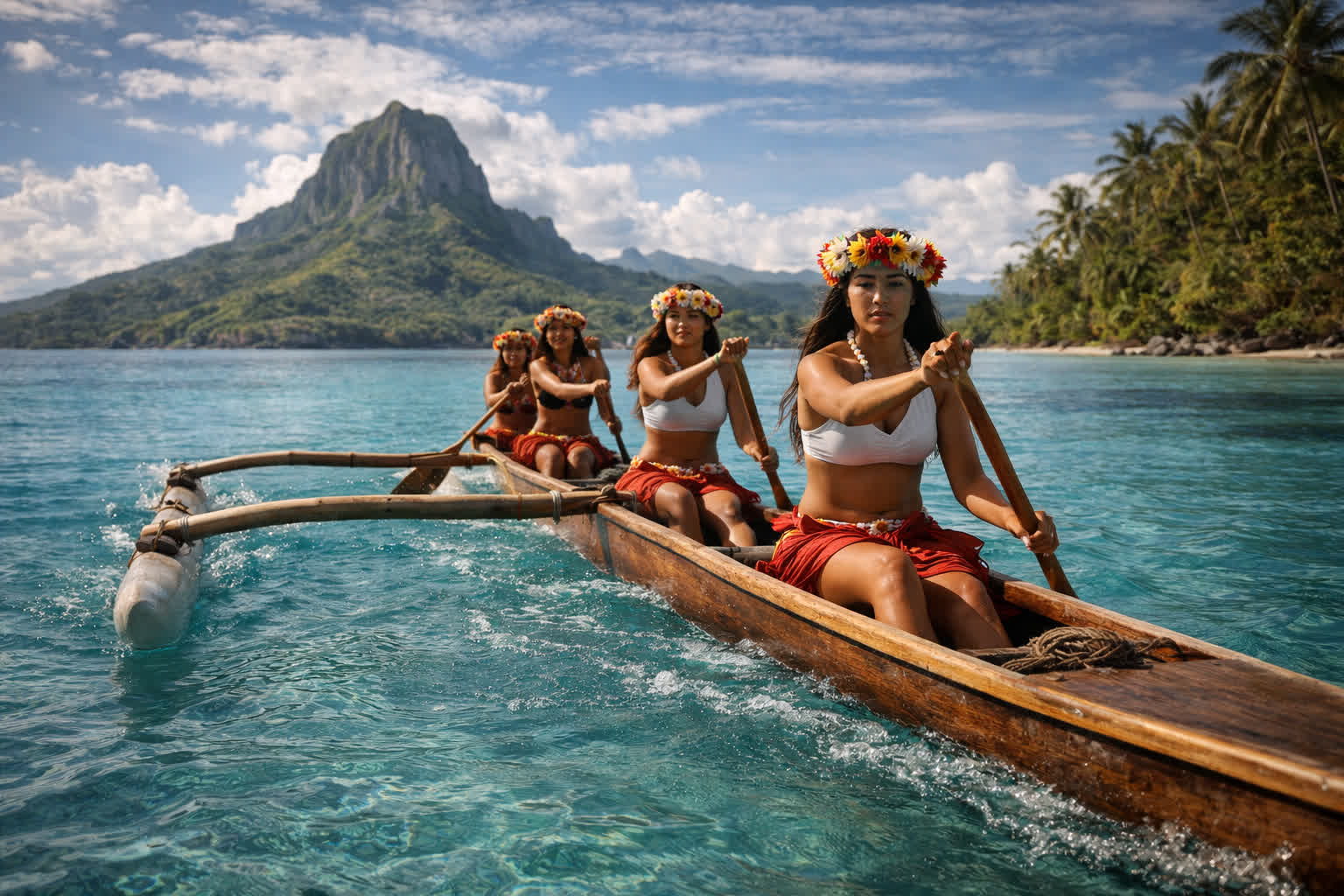
Polynesian canoeing, known worldwide as Va’a, is not just a sport — it is a millennia-old cultural heritage that crossed oceans and today finds on the coast of São Paulo one of its most promising scenarios in Brazil.
Between the cities of Praia Grande, Santos, and the entire Baixada Santista region, this practice is steadily growing, combining physical performance, connection with nature, and the spirituality of Pacific cultures such as Tahiti and the universe of Ori Tahiti.
What is Polynesian canoeing (Va’a)?
Polynesian canoeing originated more than 3,000 years ago in the Pacific islands, where it was used as the main means of transportation between archipelagos.
Unlike traditional canoeing, Va’a has a unique structure:
- A main hull
- A lateral float (ama)
- Connecting arms (iakos)
This design ensures stability and speed in the open ocean, allowing teams — usually up to 6 people — to paddle in perfect synchronization.
More than technique, Va’a requires rhythm, respect, and unity — values deeply connected to Polynesian culture.
Why the coast of São Paulo became a reference in Brazil
Few people know this, but Polynesian canoeing arrived in Brazil through Santos in the early 2000s.
Today, the region is considered one of the main hubs of the sport in the country.
This is no coincidence.
The geography of Baixada Santista offers ideal conditions:
- Relatively sheltered waters (such as Santos Bay)
- Safe coastal routes for beginners and advanced paddlers
- A unique landscape combining urban coastline and nature
In addition, the practice is already part of the local routine, with classes, training sessions, and paddling at sunrise and sunset.
Praia Grande emerges as a natural expansion of this ecosystem — with long beaches, space for events, and enormous yet underexplored potential.
Polynesian canoeing: far beyond a sport
The growth of Va’a is not only physical — it is cultural.
The practice carries essential elements of Polynesia:
- Team spirit (everyone paddles as one)
- Respect for the ocean
- Rhythm and cadence (like in dance)
- Spiritual connection with nature
This directly connects with the universe of Ori Tahiti, where movement, energy, and tradition walk together.
Paddling is not just movement — it is expression.
Benefits of Polynesian canoeing
The popularity of the sport in Brazil comes with clear benefits:
Physical
- Full-body muscle strengthening (core, arms, back)
- High calorie expenditure
- Cardiovascular improvement
Mental
- Stress reduction
- Increased focus
- Sense of balance and well-being
Social
- Teamwork
- Social integration
- Strong and engaged community
In addition, it is an accessible activity: beginners can start without prior experience.
Praia Grande and its untapped potential
While Santos is already consolidated, Praia Grande represents a strategic opportunity.
The city brings together:
- Beach extension ideal for events and training
- Growing public interested in outdoor activities
- Strong regional tourism
This opens space for:
- Va’a schools
- Sports and cultural events
- Differentiated tourism experiences
- Partnerships with brands and cultural projects
The scenario is clear: those who enter now, lead.
Canoeing, tourism, and culture: a new market on the coast
Polynesian canoeing is no longer just a sport — it is becoming a complete experience.
Today, it connects:
- Tourism
- Polynesian culture
- Sports performance
- Healthy lifestyle
On the southern coast of São Paulo, this is still expanding — which means open space for innovation.
Projects that integrate Va’a + culture + experience have immediate standout potential.
Ori Tahiti and the spirit of the ocean
At its core, the connection between Va’a and Ori Tahiti is natural.
Both are born from the same roots:
- Movement with purpose
- Collective rhythm
- Cultural expression
- Respect for origins
Bringing this essence to the coast of São Paulo is not just adapting a sport — it is bringing a living culture into a new territory.
How to start in Polynesian canoeing
Whether as a practitioner or a partner, the first step is simple:
- Join an introductory paddling session
- Get to know local teams
- Understand Va’a dynamics
Progress is fast — and engagement is almost immediate.
The future of Va’a on the coast of São Paulo
The trend is clear:
- Rapid growth of the sport
- Greater presence in sporting events
- Integration with tourism and culture
- Formation of new teams and clubs
Polynesian canoeing is no longer new — it is an expanding reality.
And the coastline between Praia Grande and Santos is at the center of this movement.
Conclusion
Polynesian canoeing represents something rare:
a sport that combines tradition, performance, and cultural identity.
On the southern coast of São Paulo, it finds the perfect environment to grow —
and for those who recognize opportunity, this is the ideal moment to be part of it.