
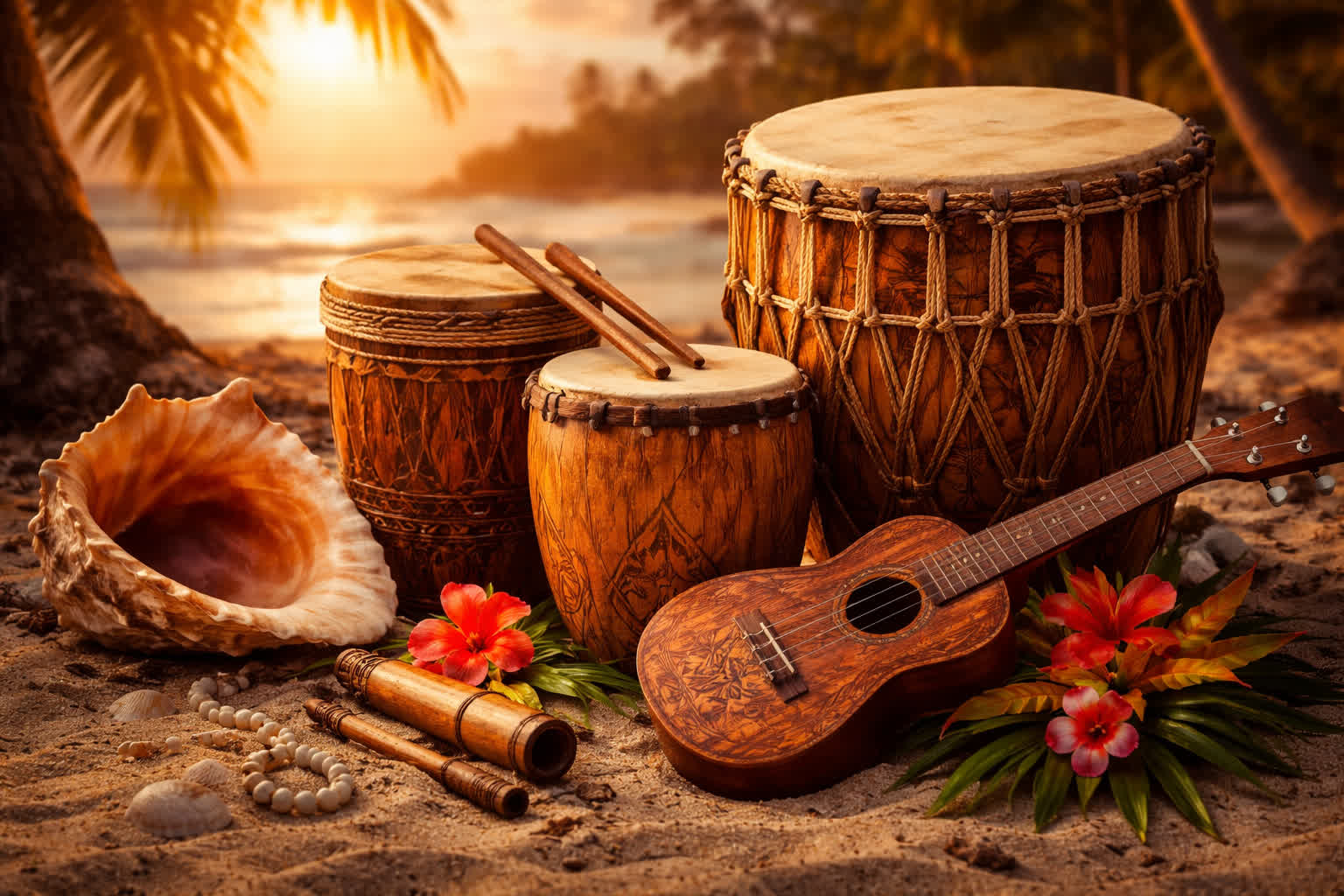
Traditional Polynesian music, particularly within the context of Ori Tahiti, is a dynamic and deeply rooted cultural expression that integrates rhythm, movement, and ancestral knowledge. Far beyond accompaniment, music serves as the structural foundation of dance, guiding tempo, intensity, and emotional narrative with precision and purpose.
At the core of this musical tradition are percussion instruments, which establish the rhythmic architecture essential to performance. The to‘ere, a slit drum carved from a hollowed log, produces sharp, resonant tones that articulate complex rhythmic patterns. It is often paired with the pahu, a vertical drum traditionally covered with sharkskin, capable of delivering deeper, more ceremonial sounds. Together, these instruments create layered polyrhythms that drive the choreography and demand technical synchronization from dancers.
Complementing the percussion is the fa‘atete, a smaller hand-played drum known for its rapid, intricate sequences. Its role is particularly prominent in faster sections, where it accentuates acceleration and highlights transitions in movement. In ensemble settings, multiple drummers interact in structured yet fluid compositions, demonstrating both discipline and improvisational awareness.
Melodic elements are introduced through instruments such as the vivo, a traditional nasal flute, and through vocal arrangements that carry linguistic and poetic significance. Songs are often performed in the Tahitian language, preserving oral traditions and reinforcing cultural identity. Lyrics may recount genealogies, honor deities, celebrate nature, or narrate historical events, embedding meaning directly into the performance.
The relationship between music and dance in Ori Tahiti is inseparable. Each gesture, posture, and sequence is informed by specific rhythmic cues, requiring dancers to internalize musical structures as part of their technical training. This interdependence ensures that performances are not merely aesthetic, but culturally coherent and symbolically rich.
In contemporary practice, traditional instrumentation continues to coexist with modern influences, yet the foundational principles remain unchanged. Authenticity is maintained through the transmission of technique, respect for ceremonial origins, and adherence to rhythmic integrity.
Within the conservatory context, the study of traditional music is essential for a complete understanding of Ori Tahiti. It develops rhythmic literacy, cultural awareness, and interpretative depth, enabling practitioners to engage with the art form in its full complexity and authenticity.